Harmonic Frequency Shifter
A VST3/AU audio plugin that combines frequency shifting with musical scale quantization for creative sound design.
What It Does
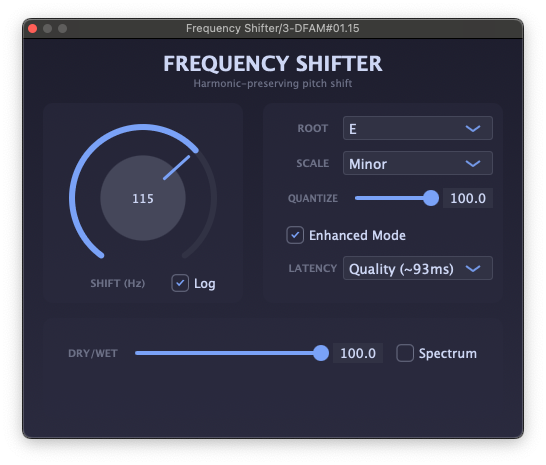
This plugin performs frequency shifting — moving all frequencies in your audio by a fixed Hz amount — while keeping the output musical through intelligent scale quantization.
Unlike pitch shifting (which preserves harmonic relationships), frequency shifting creates unique, often metallic or otherworldly tones. By adding scale quantization, you get the best of both worlds: the character of frequency shifting with musical coherence.
Features
Frequency Shift
±20,000 Hz range with linear or logarithmic control
Musical Quantization
Snap frequencies to any of 22 musical scales
Phase Vocoder
High-quality processing with minimal artifacts
Quality Modes
Low Latency, Balanced, or Quality presets
Spectrum Analyzer
Real-time visualization of frequency content
Dry/Wet Mix
Blend processed and original signals
Quick Start
- Download the plugin from the Releases page
- Install the VST3 or AU to your plugin folder
- Load in your DAW and start experimenting!
Basic Usage
| Parameter | Description |
|---|---|
| Shift (Hz) | Amount to shift frequencies. Positive = up, negative = down |
| Quantize | How strongly to snap to scale notes (0% = pure shift, 100% = fully quantized) |
| Root Note | The root of your scale (C, C#, D, etc.) |
| Scale | Choose from Major, Minor, Dorian, Pentatonic, Blues, and more |
| Dry/Wet | Mix between original and processed audio |
Creative Tips
- Metallic vocals: Shift by 50-200 Hz with 0% quantization
- Re-harmonize: Use 100% quantization to force audio into a new scale
- Subtle detuning: Small shifts (5-20 Hz) with 50% quantization for chorus-like effects
- Robotic sounds: Large shifts with the Chromatic scale
Downloads
Get the latest release for your platform:
| Platform | Format | Download |
|---|---|---|
| macOS | VST3 | Download |
| macOS | AU | Download |
| Windows | VST3 | Download |
How It Works
The plugin uses a sophisticated DSP pipeline:
The Algorithm
1. STFT (Short-Time Fourier Transform): Break audio into overlapping frames, apply window function, transform to frequency domain.
2. Frequency Shifting: Reassign each frequency bin by adding the shift amount:
\[f_{\text{new}} = f_{\text{original}} + \Delta f\]3. Musical Quantization: For each frequency, find the nearest note in the selected scale:
\[\text{MIDI} = 69 + 12 \cdot \log_2\left(\frac{f}{440}\right)\] \[f_{\text{quantized}} = 440 \cdot 2^{\frac{\text{MIDI}_{\text{quantized}} - 69}{12}}\]4. Phase Vocoder: Use identity phase locking (Laroche & Dolson) to maintain phase coherence between frames.
5. ISTFT: Overlap-add synthesis to reconstruct the time-domain signal.
For complete mathematical details, see Algorithm Documentation.
Documentation
- User Guide — Complete parameter reference and preset recipes
- Algorithm Details — Full technical documentation
- Phase Vocoder — How phase coherence is maintained
- Mathematical Foundation — The DSP math behind the plugin
System Requirements
- macOS: 10.13+ (Intel or Apple Silicon)
- Windows: Windows 10+
- DAW: Any VST3 or AU compatible host
Source Code
This project is open source! Check out the GitHub repository to:
- Browse the source code
- Report issues
- Contribute improvements
- Build from source
Acknowledgments
Based on established DSP techniques:
- Phase vocoder (Laroche & Dolson, 1999)
- STFT overlap-add (Allen & Rabiner, 1977)
- Identity phase locking for improved quality
Questions? Open an issue on GitHub.